Governed model gateway
Wardwright
Agents call normal OpenAI-compatible model names. Wardwright decides what those names mean: which provider or local model to use, what policy rules apply, when to retry, reroute, block, or rewrite output, and what receipt should be recorded afterward.
v0.0.11 release line includes the Lustre workbench migration,
framework-adapter recipes, local agent-adapter install/probe support, and the
first Wardwright-hosted server-tool plus tool-mediation controls.
Wardwright is for teams and operators who want model behavior to be a reviewed, testable contract instead of scattered prompt strings, provider IDs, and retry logic inside every agent.
Today, Wardwright can run as a local or remote service, define Wardwright
models, simulate policy behavior in the /admin workbench, record receipts,
and exercise early policy examples such as routing decisions, stream governance,
output checks, retries, and saved simulator test cases. Operator workflows start
from /admin; old /policies links redirect there. The admin surface currently
supports basic auth, while individual models can be configured for API-key or
open access.
Install
Wardwright publishes native binaries through GitHub Releases and Homebrew.
macOS Homebrew
brew tap bglusman/tap
brew install wardwright
wardwright admin
Linux
curl -fsSL https://raw.githubusercontent.com/bglusman/wardwright/main/scripts/install.sh | sh
WARDWRIGHT_SECRET_KEY_BASE="$(openssl rand -base64 64)" \
WARDWRIGHT_BIND=127.0.0.1:8787 \
~/.local/bin/wardwright serve
Set WARDWRIGHT_ADMIN_TOKEN before exposing Wardwright beyond loopback. See
Packaging for manual archive install steps and service
details.
For an end-to-end example of why the workbench and framework recipes matter, see Build A Lightweight News Monitor.
What Wardwright Adds
Wardwright is a narrow control point between agent code and concrete model providers.
Stable Model IDs
Expose names such as coding-balanced while Wardwright owns
the model graph and policy behind them.
Model Composition
Route to provider targets, delegate through other Wardwright models, and keep context-window and fallback choices explicit.
Policy And Repair
Apply request, route, stream, output, history, alert, and tool controls, including bounded stream retries and rewrites.
Receipts
Record caller provenance, selected routes, provider attempts, policy actions, and final status for each run.
Policy Workbench
The installed app includes a workbench at /admin for visualizing and
simulating Wardwright models before using them behind real traffic. Choose the
registered Wardwright model being simulated, load a fixture, edit the simulated
request, model output, and retry attempts, then step through the resulting
policy run.
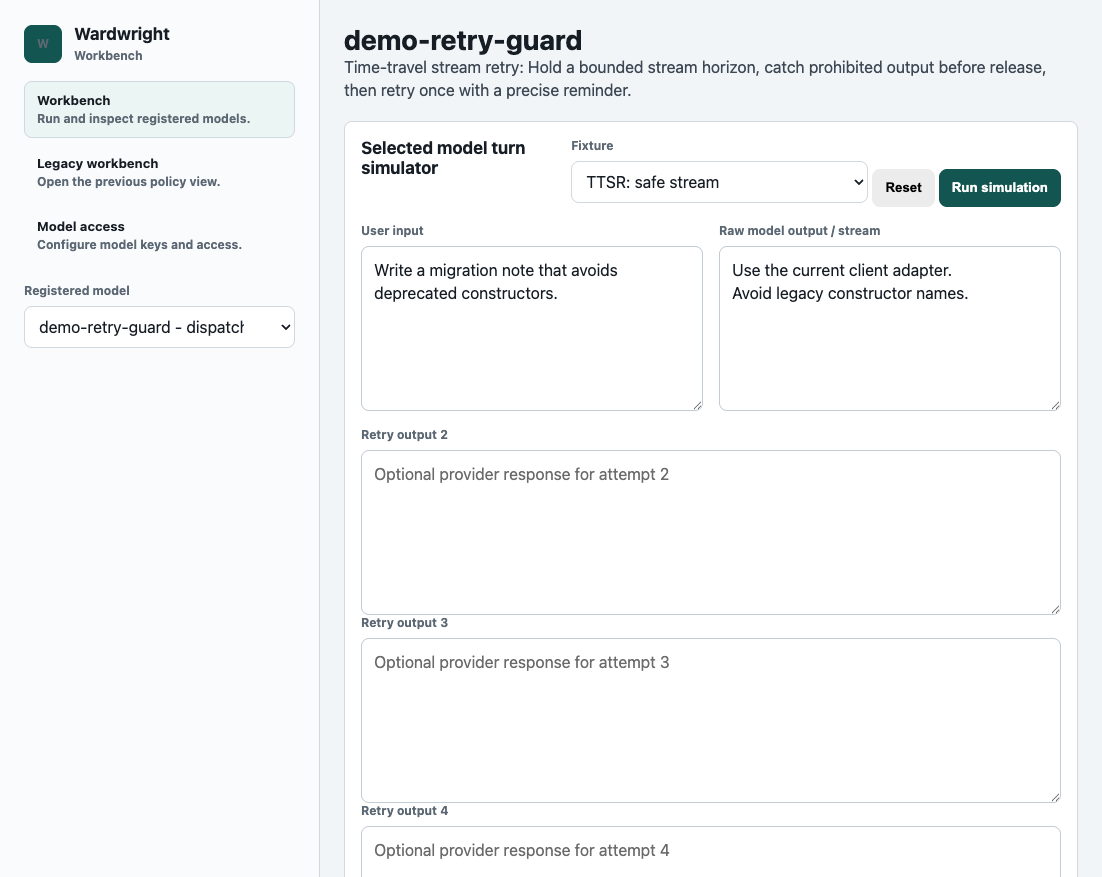
Fresh installs include starter examples for output contracts, route/model composition, stream repair and session state, plus tool/workflow control. Locally authored models use the same workbench path when they expose a supported projection, and reviewed turns can be saved as reusable simulator test cases.
See Policy Workbench for screenshots and examples. External
agents can use wardwright tools, /mcp, and the protected authoring APIs; see
Agent Authoring for the review workflow.
Adapter install and validation commands are covered in
Agent Adapters.
SDK and application-framework recipes are tracked separately in
Framework Adapters.
Provider Credentials
Wardwright can call local Ollama without credentials. OpenAI-compatible provider
targets can reference secrets through credential_fnox_key or credential_env.
Fnox is a secret lookup path, not Wardwright authentication; keep real provider
credentials on loopback-only instances or behind a trusted auth boundary. See
Provider Credentials.
Current Runtime
The active app is a Phoenix service with a Lustre operator workbench. Elixir
owns Phoenix, HTTP/API boundaries, provider calls, storage drivers, PubSub, and
top-level supervision; Gleam owns correctness-heavy policy logic and new
workbench behavior. Runtime state is being evaluated for gleam_otp migration
where typed actors can remove invalid states or clarify concurrency ownership.
Current capabilities include:
- OpenAI-compatible
/v1/chat/completionsand/v1/modelsendpoints. - Wardwright model routing with provider targets and route-DAG delegation.
- Request, route, stream, output, history, alert, and tool policy behavior.
- Protected authoring APIs, MCP, receipts, simulations, and admin status.
- Workspace recipe loading for seeded and local model examples.